
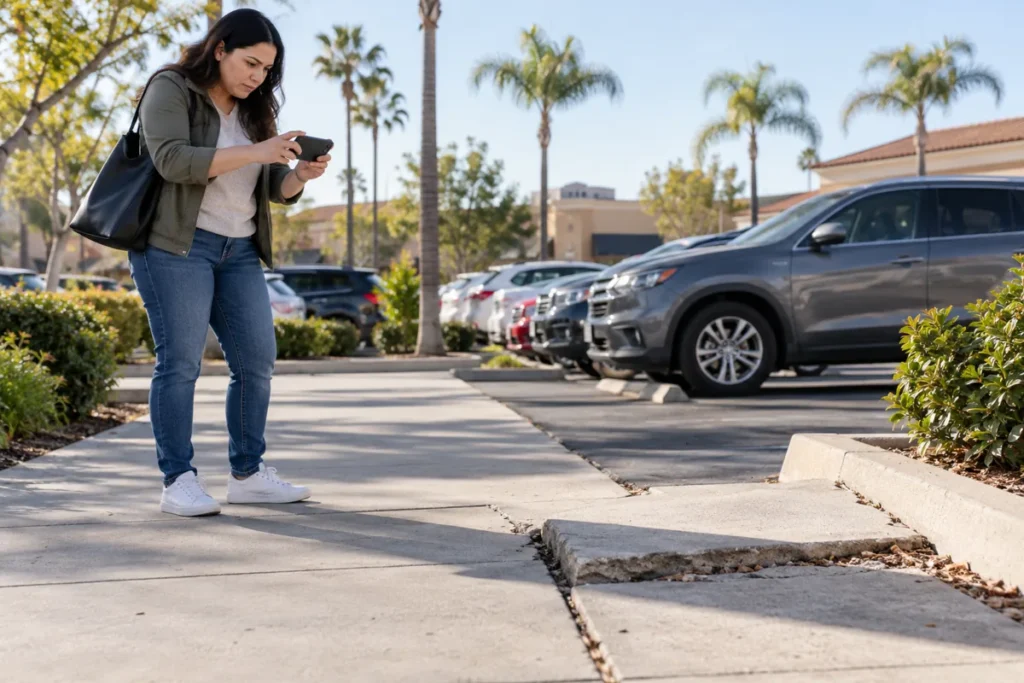
AI-generated fictional image; not an actual client, property, or case.
A parking lot fall in California can turn an ordinary shopping trip into an injury, missed work, and uncertainty about who should help. You may remember catching your foot on uneven pavement but not know who maintains the walkway. Start with your health, then preserve what you can safely document. You do not need to solve the entire liability question at the scene.
Get help before gathering evidence
Move away from traffic if you can do so safely, and ask someone to help. Call 911 for an emergency. Seek appropriate medical evaluation rather than delaying care to take photographs or finish an incident report. Explain how you fell and describe symptoms accurately without guessing at a diagnosis.
Keep discharge instructions, appointment information, and receipts together. If symptoms change, tell your healthcare professional. A brief, honest record of difficulties with walking, sleeping, or ordinary tasks can also help you explain your experience at appointments.
Photograph the location, not just the injury
If it is safe, take both wide views and close-ups. A close-up may show broken concrete, while a wider photograph explains where it was in relation to the store entrance, parking spaces, curb, or pedestrian route. Helpful details include:
- The exact spot where your foot slipped or caught.
- Uneven surfaces, loose material, liquid, or other conditions you actually observed.
- Lighting, shadows, signs, barriers, and the surrounding walking route.
- Nearby business names and landmarks that identify the location.
- The date and approximate time, recorded separately in your notes.
Do not step into traffic, enter restricted areas, move objects, or recreate the fall. If someone photographs the location later, record when the pictures were taken; conditions may have changed. Preserve original files rather than only cropped images shared through messages.
Report the incident and identify witnesses
Tell the property manager, store manager, or security staff what happened. Ask for an incident number and a copy of any report you complete, while recognizing that a business may not immediately provide its internal records. Keep your own dated account of whom you spoke with and what you reported.
Ask willing witnesses for contact information and what they personally saw. Do not coach their answers. Note visible cameras and promptly ask that relevant footage be preserved. A preservation request is not a guarantee that footage exists or will be released; a lawyer can help pursue available evidence.
Does a fall automatically make the property owner responsible?
No. California’s civil jury instructions on premises liability, CACI 1000 and 1003, explain that responsibility involves more than the fact of an injury. Relevant questions include who controlled the property, whether negligent maintenance or use contributed to the harm, and whether an unsafe condition was known or reasonably should have been discovered.
Inspections, prior complaints, maintenance records, warnings, and the circumstances of the fall may matter. The store name on a receipt does not necessarily identify everyone responsible for a shared parking area. Our slip-and-fall practice page introduces these premises-liability issues.
Keep the financial and medical picture organized
Save treatment records, bills, related receipts, and documents showing missed work. Keep footwear and other relevant items in their existing condition, and ask your lawyer about preservation. Compensation depends on evidence, responsibility, and the particular losses; a photograph alone does not establish a settlement amount.
For organizing supporting documents, our medical-bills guide explains issues that can arise while an accident claim remains pending. The evidence checklist in our falling-merchandise article also discusses documenting an incident at a business.
Check deadlines early, especially on public property
A municipal lot or other government-controlled property can involve different rules. The California Courts explain that injury claims against government agencies generally must be submitted within six months, with exceptions and additional lawsuit deadlines. An ordinary incident report is not necessarily the required government claim. Get advice promptly rather than assuming that insurance discussions protect a deadline.
Need help understanding your options?
The L.A. Law Firm can review the location, evidence, injuries, and possible next steps. Contact our team or call 866-383-1462. Phone intake is available 24/7; office visits are by appointment. Every case is different, and no result is guaranteed.
General educational information, not individualized legal or medical advice.


