
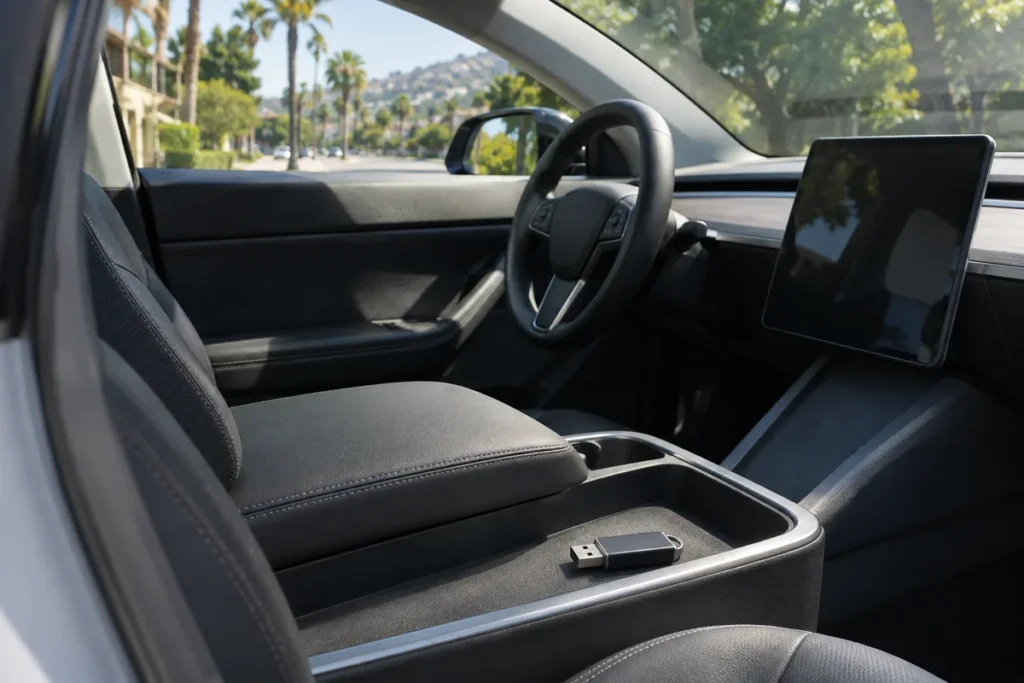
Injured in a California crash involving a Tesla that may have been using driver assistance? Save the facts before accepting anyone’s explanation that “the car was driving itself.” The vehicle’s brand does not establish which feature was active, what caused the collision, or who is responsible. After urgent safety and medical needs are addressed, an organized evidence file can help an attorney investigate those questions.
Image disclosure: AI-generated fictional illustration of a generic parked electric-car interior; not an actual Tesla vehicle, accident, client, or item of case evidence.
Supervised driving is not the same as a driverless ride
Tesla’s current FSD (Supervised) guidance says its enabled features require active driver supervision and do not make the vehicle autonomous. Available features can vary with the vehicle, hardware, software, and region. Separately, NHTSA’s driver-assistance overview explains that Level 2 assistance can control steering and acceleration or braking while the driver remains engaged and responsible for driving.
That distinction matters, but it does not decide an individual injury claim. A feature’s presence, a driver’s statement, or a news headline is not proof of its operation at the moment of impact. Do not assume every Tesla collision involves FSD or that a software issue has been established.
Write down what you actually observed
Call 911 for injuries or an emergency, and follow responders’ instructions. Do not approach a damaged electric vehicle or enter traffic to inspect cameras or a screen. Once safe, record the location, direction of travel, approximate time, lanes, signal conditions, and sequence of impacts. Separate firsthand observations from information someone told you afterward.
If another driver mentions Autopilot or FSD, note their words accurately without arguing about fault. Keep witness contacts and the investigating agency’s report number. Our accident-damage documentation guide explains why wider scene views can be as useful as close-up damage photographs.
Keep video and vehicle details without changing them
- Original video: Preserve available dashcam files, including footage before and after the impact. Keep an untouched copy rather than only an edited social-media clip.
- Vehicle identification: Save the plate, model, year, and VIN from documents you lawfully possess. Do not publish another person’s identifiers online.
- Feature information: If you own the vehicle, record the displayed software version and relevant messages when safely available. Do not recreate the maneuver or change settings to test a theory.
- Repair and support records: Keep towing information, repair estimates, service history you possess, support correspondence, and any account-download acknowledgment.
Can Tesla provide every recording?
No such assumption is safe. Tesla’s account-data request guidance describes information an account holder may request, including certain vehicle and safety-event data. It also explains that Dashcam and Sentry Mode recordings are not shared with Tesla and that some information may not be retained or included in a standard request. An account export is not a guarantee that every relevant recording or technical log will be provided.
Tell your attorney promptly if a vehicle, storage device, or potentially important record could be repaired, overwritten, sold, or discarded. Ask about appropriate preservation and inspection steps before altering evidence. A passenger or another road user should not try to access someone else’s account or remove a storage device from their vehicle.
Connect the investigation to your injuries
Technology questions should not displace your recovery. Describe symptoms honestly to your clinician, follow individualized medical advice, and keep treatment records, bills, work restrictions, and insurer letters. Our medical-bill and EOB checklist can help organize expenses. Bring available records and unanswered questions using our consultation checklist; you do not need to diagnose the software yourself.
If someone else’s negligence injured you in Los Angeles, Southern California, or Northern California, The L.A. Law Firm can review your circumstances and explain possible options. Call 866-383-1462 or contact our team. Phone intake is available 24/7; office visits are by appointment. This is general educational information, not individualized legal, medical, or insurance advice. No result is guaranteed.


